Trial and strategy
Argue against yourself first.
Witnesses, exhibits, offers and the authority you hold, in the one place you actually open before a hearing — and a way to hear the other side's best argument while there is still time to change yours.
Said before anything else
It does not predict outcomes
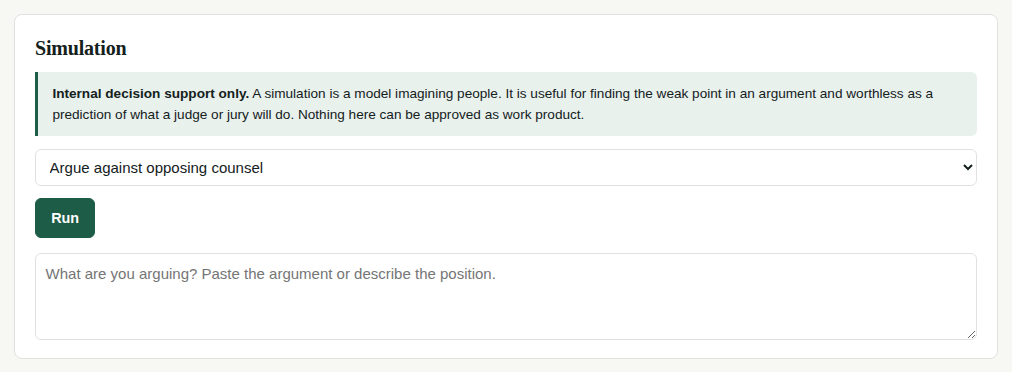
A simulation is a machine imagining people. It is useful for finding the weak point in your own argument and worthless as a prediction of what a judge or jury will do, and it is labelled that way everywhere it appears — including on the screen where you run it.
Nothing it produces can be approved as work product. It is internal decision support, and treating it as anything else would be the mistake this labelling exists to prevent.
What is here
Trial notebook and simulation
Witnesses, exhibits, offers, and the authority you hold are in the one place you actually open before a hearing. And you can hear the other side's best argument while there is still time to change yours.
Simulations put your argument to a simulated opposing counsel, bench, or jury panel. They are labelled internal decision support at the database level and can never become approved work product. Valuation asks the model for outcomes and probabilities and computes the expected value in code.
- A simulation is a model imagining people. It is useful for finding weak points and worthless as a prediction, and the interface says so.
- Depositions are here and are worth knowing about: a witness on the list can have an outline built for them from the matter's own record — organized by topic, each topic naming the admission it is for and the document that impeaches a denial. It is run from Chambers rather than from this page, which is where the strategy verbs live.
- Exhibits and settlement offers are recorded and read back; the trial-item and matter-budget tables in the same migration have no screen and no code behind them at all. They are schema, not capability, and nothing in the product will fill them.