Small and midsize litigation firms.
The record, read in full. Every night.
An AI-native practice platform that runs the whole case — intake to close-out — and shows its work on every page.
Roberts v. Meridian Freight — from the record
Driver log ends at Ocala weigh station, 21:40.D-0214
Dispatch email places the truck in Valdosta at 21:15 — contradicts the log.D-0389
Incident report filed, 06:12; no mention of the Valdosta stop.D-0007
The contradiction turns up in week one
Not in month six. Every arriving document is compared against the whole record while there is still time to do something about it.
The chronology already exists
Sourced line by line, and it prints as an exhibit — instead of being built by hand the week before a hearing.
You can check every answer
Ask the file a question and each claim links to the page it came from. An answer you cannot check is an answer you have to redo.
Deposition, month nine
The witness is certain. The file is not.
Every claim in the record was compared against every other the night it arrived — so the disagreement was flagged, cited, and waiting in the outline.
TRANSCRIPT — D-0214
THE FILE DISAGREES
Dispatch email places the truck in Valdosta at 21:15.
D-0389 · 2025-03-14Fuel receipt, Valdosta Pilot #44, 21:32.
D-1104 · 2025-03-14What it does
Six things a litigation practice actually runs on
Each of these is built and in use. The pictures are the real product, photographed from our demonstration matter.
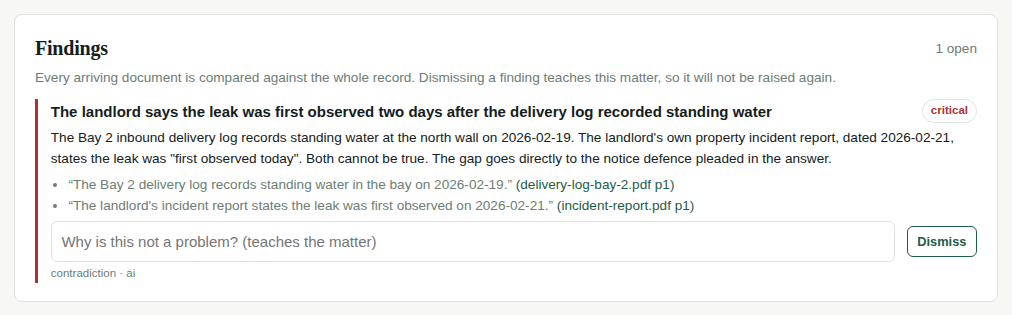
Automatic forensic pass
The contradiction you would have found in month six turns up the week the document arrives, while there is still time to do something with it. It also catches the dull expensive things — Bates gaps, a date that cannot be right.
Every arriving document is compared against the whole record for contradictions, gaps, and impossible dates.
The fact ledger
A ten-thousand-page production becomes something you can ask questions of rather than something you have to read. The reading happens once, overnight, and every answer afterwards arrives with the page it came from attached.
Every document is read once and turned into individual facts, each with the exact quote and page that supports it.
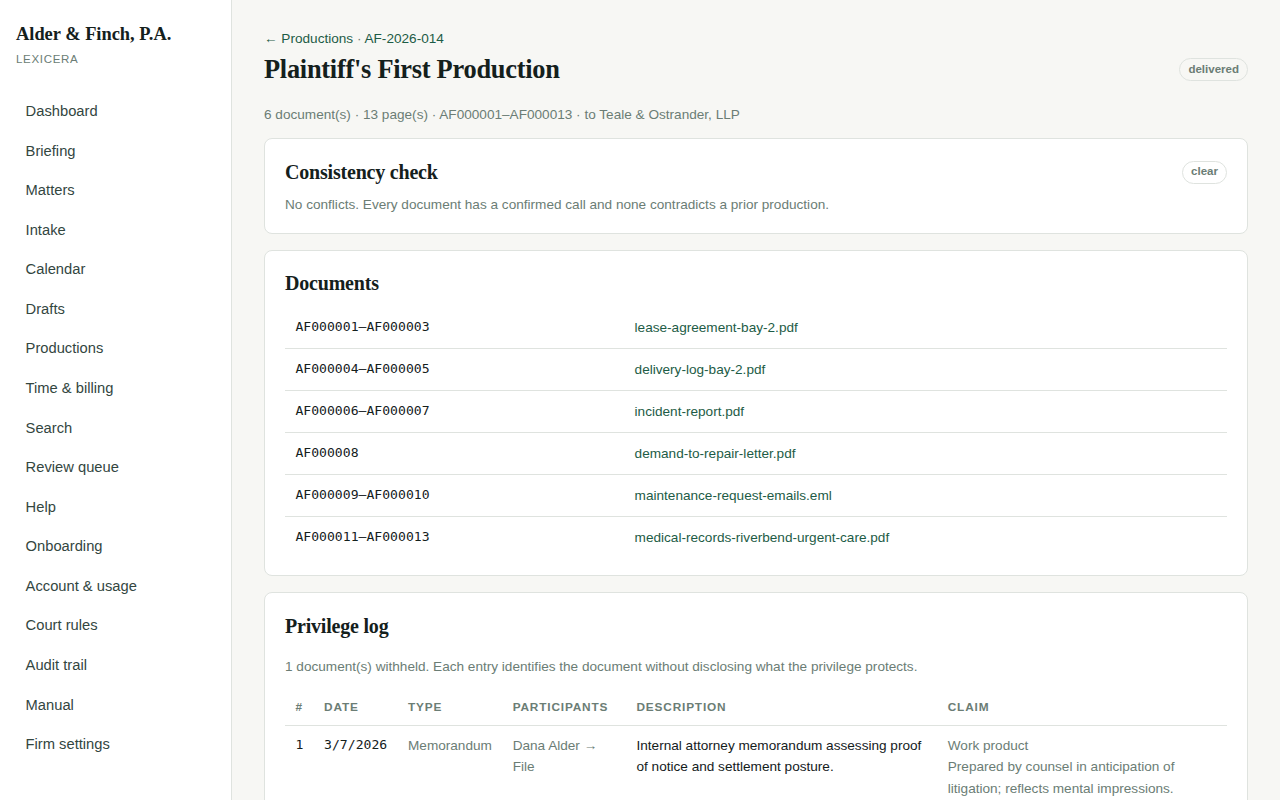
Discovery and productions
Productions go out with Bates numbers that still resolve two years later, a privilege log that wrote itself, and a receipt of exactly what was sent and when. The check that stops you producing today what you withheld last spring runs before the production can lock.
Pre-sorted responsiveness and privilege, Bates numbering that resolves forever, automatic privilege logs, and secure delivery with receipts.
Drafting with cite-check and red team
A first draft that already cites this matter's own record, plus a read of the other side's best answer, before you have spent an afternoon on it. What comes back is a draft to edit — every legal citation in it is resolved against a public opinion database, and one that does not resolve is marked unciteable.
First drafts from the record, checked against it, and argued against before they leave.
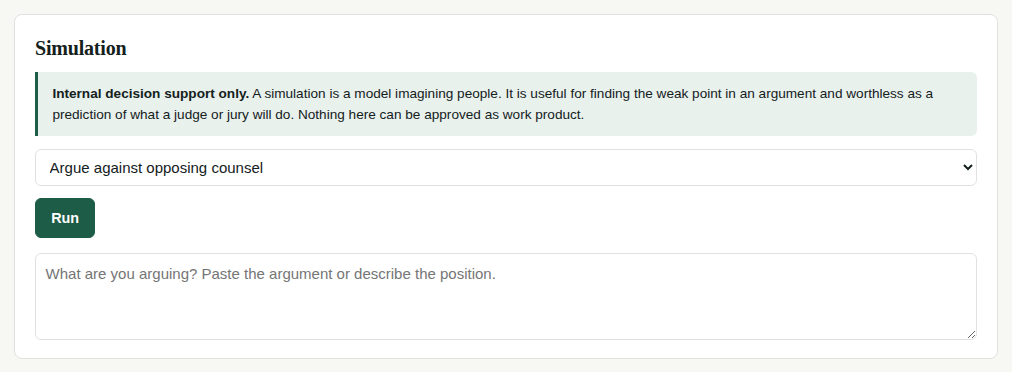
Trial notebook and simulation
Witnesses, exhibits, offers, and the authority you hold are in the one place you actually open before a hearing. And you can hear the other side's best argument while there is still time to change yours.
Witnesses, exhibits, settlement history, valuation — and a way to argue against yourself before someone else does.
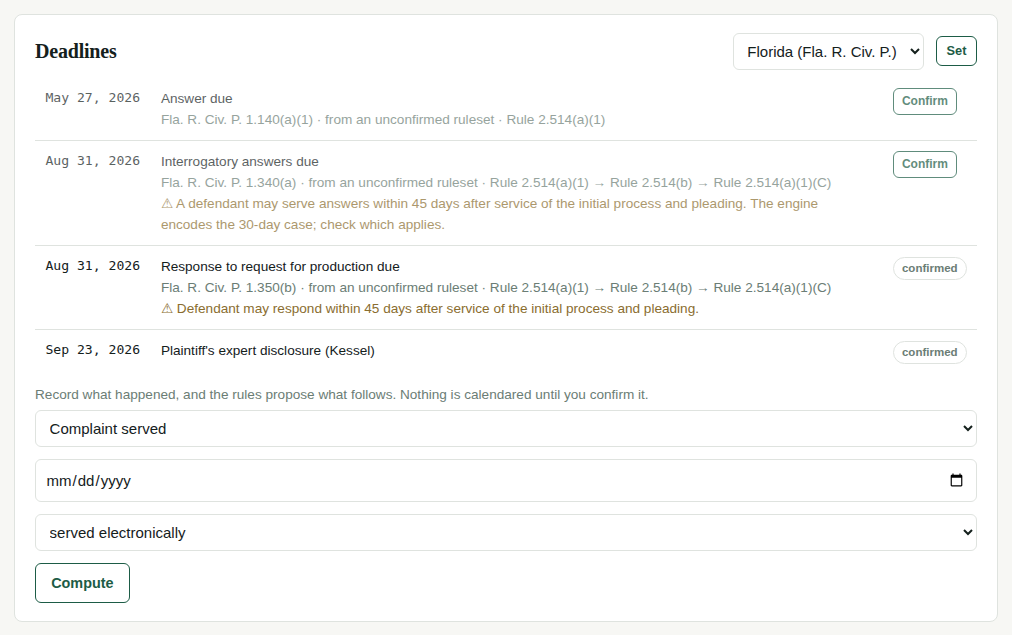
Court-rules deadline engine
The dates that follow from what just happened are worked out for you, each showing the rule and the counting behind it, so calendaring is a two-minute review instead of an hour with the rules open. Nothing reaches your calendar until you say so.
Record what happened; the rules compute what follows — and an attorney confirms every date before it is calendared.
The whole practice, one platform
Not a research tool. The way the firm runs.
Every capability below is live in the platform today, and every one of them writes to the same record — so the work compounds instead of scattering across tools. There are 59 of them, and each one carries what it deliberately does not do.
Get a case in
Know the file
Never miss a date
Make the work product
Run the firm
- Client portal
- Passive time capture and billing
- The meter and the prepay gate
- Firm administration
- Disbursement statements
- Spend limits and alerts
- Seats, roles, and what each can do
- Your own address for the portal
- The cost-recovery clause, written for you
- Sending the bill, and chasing it politely
- Automatic monthly payments, authorized by the client
- Clients, cases, and who is paying for what
- What the client agreed to pay, in plain language
- Fees the other side pays, demarcated as you work
- The settlement statement, computed from the agreement
- The bill you read before the client does
- Accounts, sign-in, and two-factor
- Setting the firm up
- What it actually saved you
On the roadmap — scoped, not yet built
The client portal, visible · Live deposition support · Who got which copy · Tracking beacons in what you receive · A written continuity commitment
Two ways to start
See it on a real file
A demonstration on our own demo matter, end to end: what arrives, what the file does with it, and what the ledger says it cost. Half an hour.
Or send us one matter
The honest test is your own documents. Pick one closed case with real volume in it and we will run it end to end — read, findings, chronology — and show you what came out, including anything it got wrong. The first run is free and still fully metered, so it ends on a ledger showing what the work cost; a $350 pilot above that takes a case of up to about 5,000 pages.